
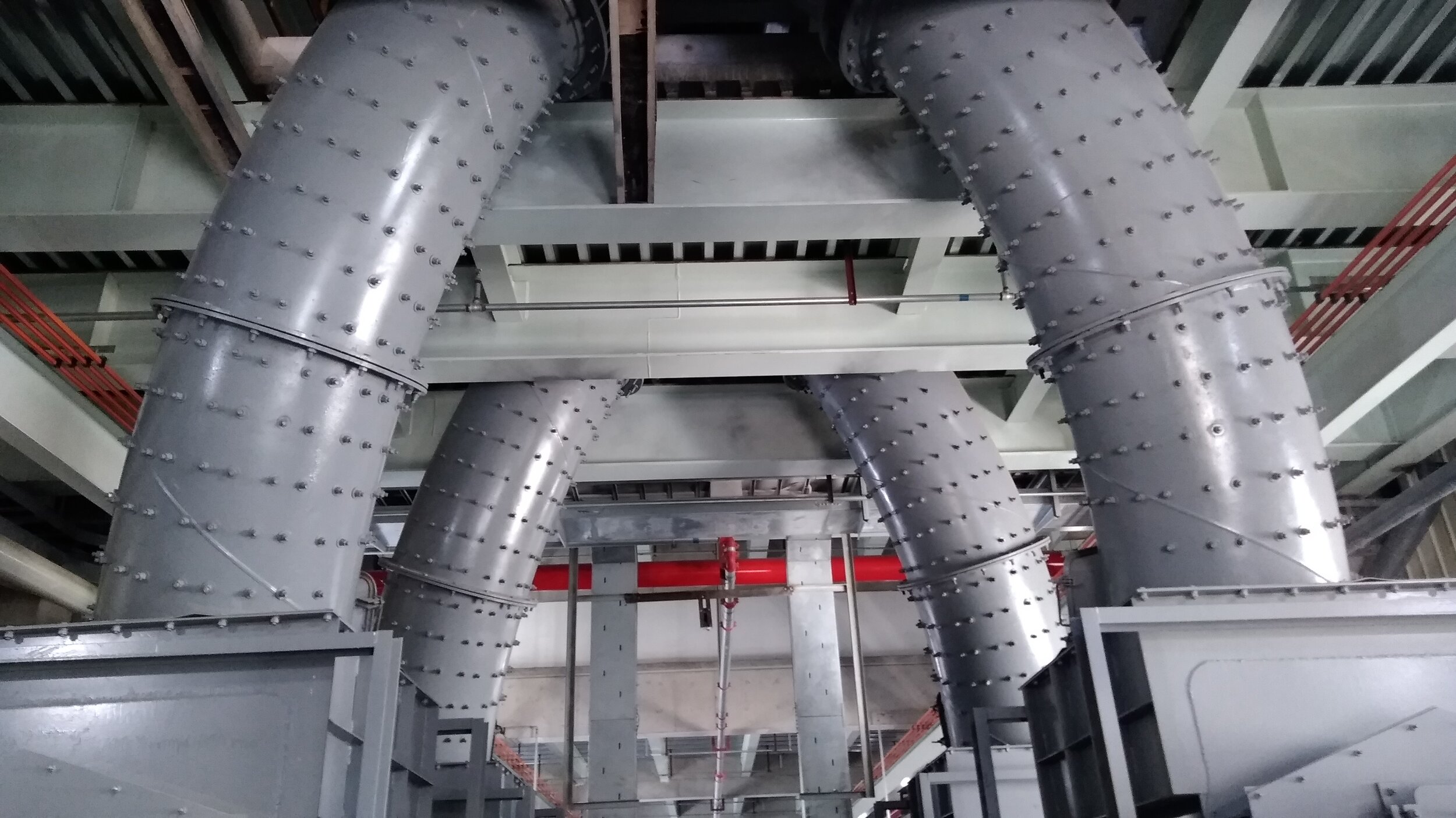
Flow-Curve Transfer Chute
Engineered bulk material transfer that controls material velocity, reduces fugitive dust, and extends wear component service life in bulk material conveying applications.
FLOW-CURVE TRANSFER CHUTE
THE PROBLEM
Conventional Transfer Points
In a conventional gravity-drop transfer chute, bulk material free-falls onto the receiving belt below with a trajectory and speed that rarely matches the receiving belt. The freefall induces airflow into the material stream and the resulting impact creates more wear, dust, and maintenance headaches.
While downstream suppression equipment can help manage dust at the exit, it only treats the symptoms, not the root cause.
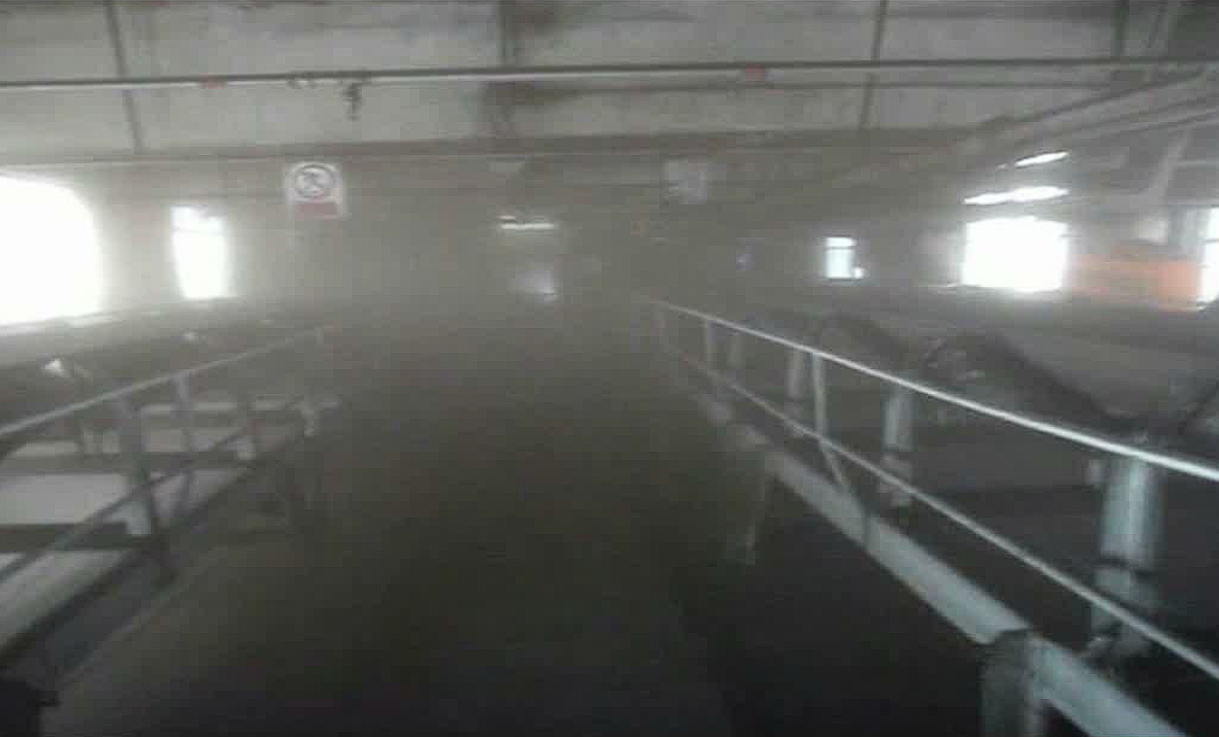
BEFORE: Accumulated dust in the air at a coal power plant transfer station — a common consequence of conventional gravity-drop chutes.
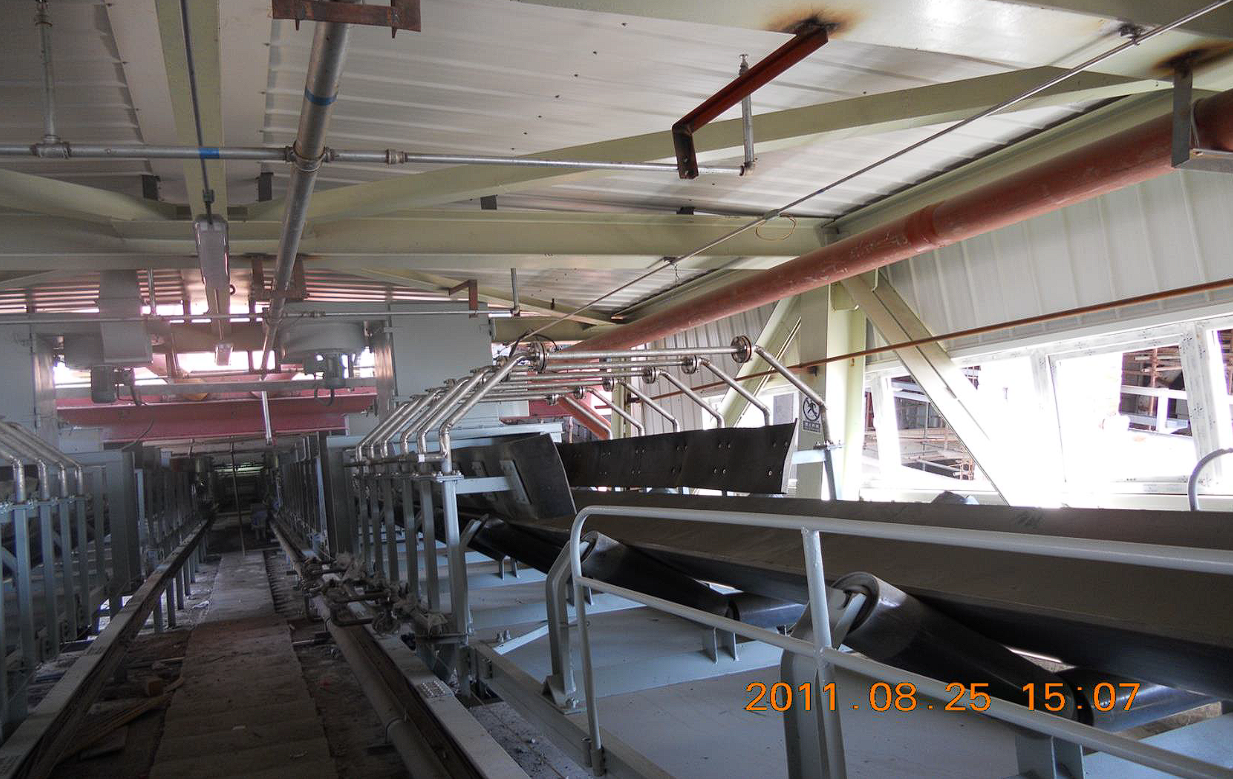
AFTER: The same transfer station following the installation of the Flow-Curve chute. Airborne coal dust is virtually eliminated.
dust generation
Free-falling material streams catch air as they drop. When they impact the conveyor, the abrupt stop acts like a splash, driving entrained air outward and dispersing dust into the surrounding environment.
Chute plugging
At conventional rectangular transfer chutes, the chute geometry creates steep impact angles, naturally forming dead zones at the corners. These stagnation zones are the first to clog and plug when particle sizes change or in high moisture conditions.
COMPONENT WEAR
High-speed material drops and mismatched belt velocities cause severe impact damage and abrasive wear across the conveyor frame, rollers, and belt.
Off-center loading and belt tracking
Uncontrolled material flow can cause off-center loading. Material placement on the receiving belt shifts randomly, causing belt drift, spillage, and edge damage.
THE SOLUTION
Flow-Curve Transfer Chute
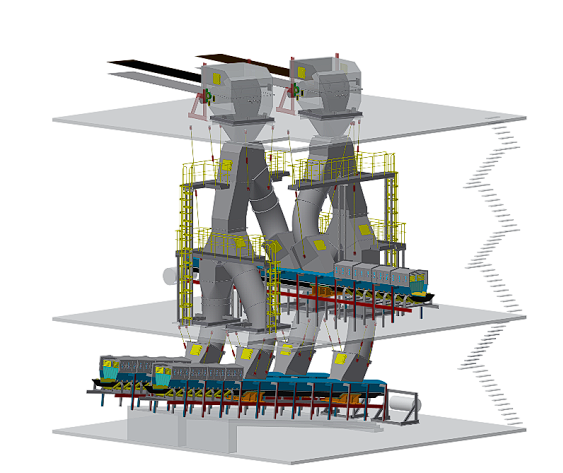
The Flow-Curve system replaces freefall with controlled sliding. Material moves along a curved, enclosed path, with exit velocity matched to receiving belt speed. Dead zones are minimized, velocity mismatch is eliminated at the loading zone, and impact and dust are dramatically reduced.
DEM Simulation
MATERIAL CHARACTERIZATION
We gather your material data, such as particle size distribution, bulk density, and moisture range.
DEM CALIBRATION
We input these exact parameters into our DEM software, simulating how your specific material behaves.
CUSTOM CHUTE DESIGN
The Flow-Curve chute is designed and simulated to minimize impact and match the material and belt speed, all before any fabrication is done.
A video showing DEM modeling for a coal power plant transfer station. Note the lack of low speed dead zones (red).
DOUBLE BELT LIFE AND REDUCE DUST
The Flow-Curve chute reduces impact, matches exit velocity to the belt, and ensures center loading, which minimizes maintenance and wear. In our installations, we’ve typically seen conveyor belt service life improvements of 50-100%, effectively doubling the amount of time between replacement.
We’ve also seen up to 90% dust reduction as measured by a third-party lab, drastically improving health and work environment outcomes.
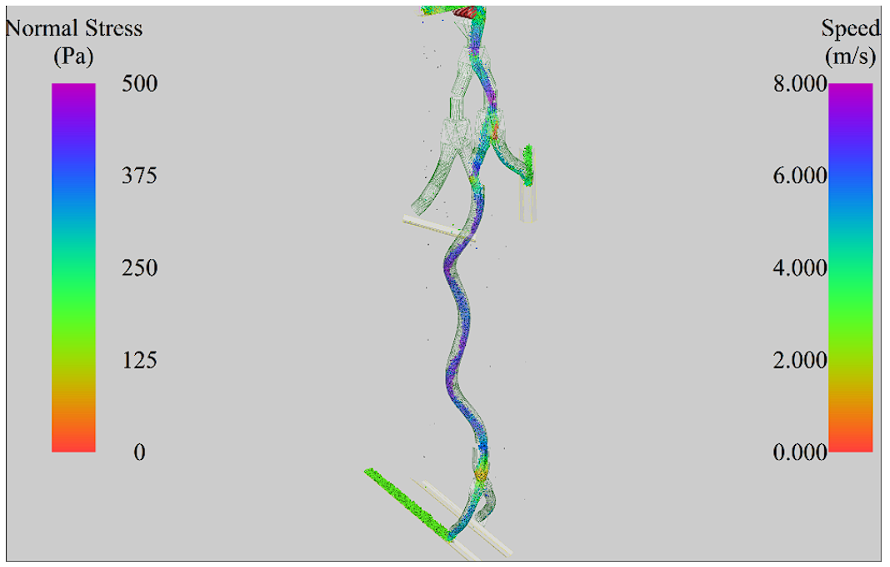
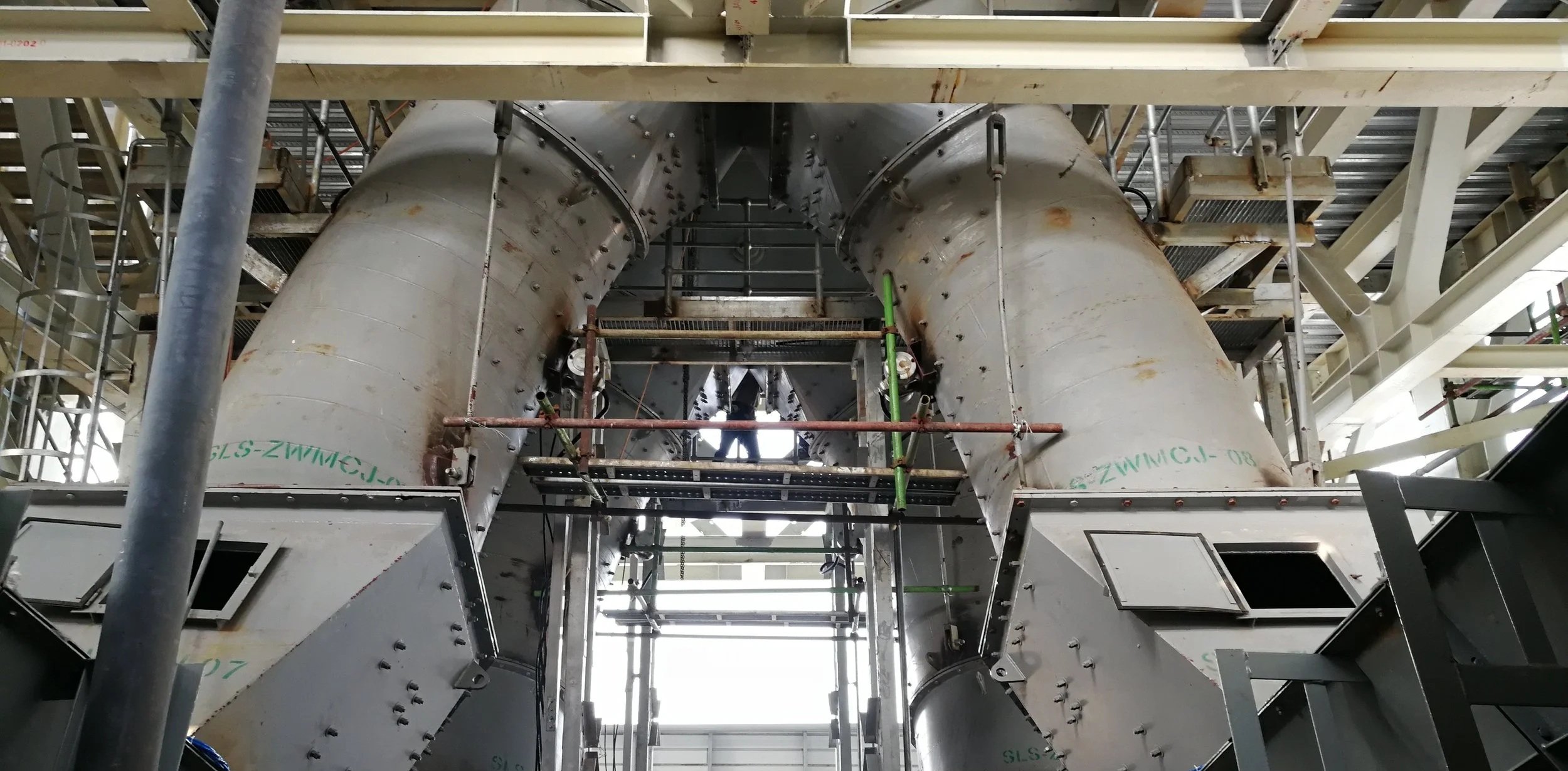
A 45 meter (148 feet) drop retrofit at a 2×1000MW capacity power plant. DEM Modeling helps smoothly control material flow even under demanding conditions.
OPERATING RESULTS
Third-Party Dust Measurement RESULTS
Zhejiang Zhongyi Testing Research Institute, an accredited occupational health testing laboratory, conducted post-installation airborne dust sampling at the coal pulverization room of Wushashan Power Generation Co., Ltd., a 2,400 MW coal-fired power plant. All 12 respirable dust concentration measurements passed the occupational health reference value following installation.
Sampling Conditions
| Belt | Date | Temp | Pressure | Humidity |
|---|---|---|---|---|
| Belt 1 | 2015-03-20 | 14 °C | 102.0 kPa | 52% |
| Belt 2 | 2015-03-24 | 16 °C | 102.0 kPa | 42% |
Respirable Dust Concentration
GBZ/T 192.2-2007 · Gravimetric · Reference value (8-hr TWA): 2.5 mg/m³ · Respirable particles are the primary metric for coal dust disease
| Pt | Location | mg/m³ | vs ref |
|---|---|---|---|
| 7 | Belt 1 Head (1) | 1.92 | Pass |
| 8 | Belt 1 Head (2) | 1.83 | Pass |
| 9 | Belt 1 Mid (1) | 1.42 | Pass |
| 10 | Belt 1 Mid (2) | 1.33 | Pass |
| 11 | Belt 1 Tail (1) | 1.33 | Pass |
| 12 | Belt 1 Tail (2) | 1.42 | Pass |
| 19 | Belt 2 Head (1) | 1.75 | Pass |
| 20 | Belt 2 Head (2) | 1.67 | Pass |
| 21 | Belt 2 Mid (1) | 1.25 | Pass |
| 22 | Belt 2 Mid (2) | 1.58 | Pass |
| 23 | Belt 2 Tail (1) | 1.33 | Pass |
| 24 | Belt 2 Tail (2) | 1.83 | Pass |
These measurements characterize dust concentrations at fixed points in the loading zone under normal operating conditions. The testing laboratory conducted supplementary CTWA analysis and noted that workers with time-in-zone below 8 hours per shift would meet the national standard at all measurement points.
Zhejiang Zhongyi Testing Research Institute Co., Ltd. Report No. WT15033-01. Standards GBZ/T 192.1, 192.2, and 192.4-2007.
WEAR PERFORMANCE
Custom Liners
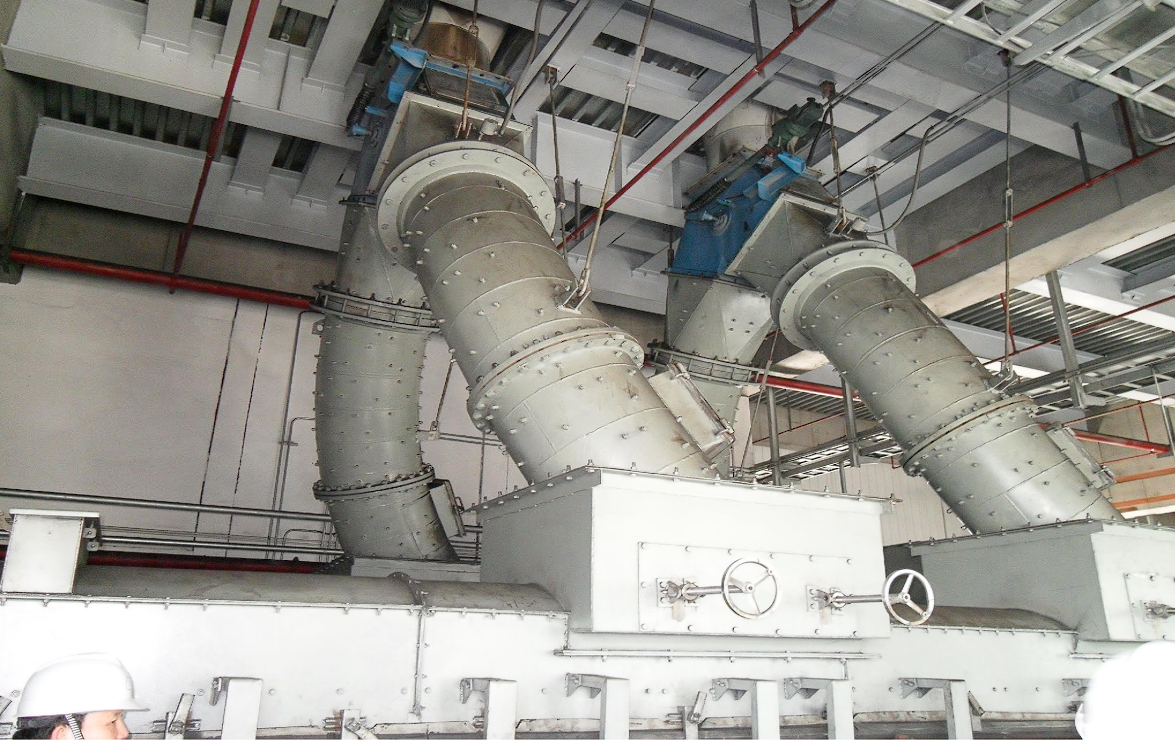
Liner selection is matched to the specific material, impact conditions, and maintenance cycle of each installation, and are custom-formed to match the Flow-Curve’s chute geometry.
For highly abrasive applications, we use a custom alloy liner that has a documented lifespan of 8 years handling abrasive coal, as seen at the Jawa 7 Ultra-Supercritical Power Plant.
For others, we choose alternatives like rubber, polymers, or ceramics to best balance impact, abrasion, and flow according to the material need. Modular chute and liner design supports easy maintenance and inspection.
SELECTED INSTALLATIONS
500+ TRANSFER CHUTE INSTALLATIONS WORLDWIDE
FROM 300 MW single-unit PLANTS to 4,800 MW FULL RETROFITS
| Project | Capacity | Type |
|---|---|---|
| Shenhua Guohua Guangdong Taishan Power Plant | 5×600 + 2×1000 MW | New build |
| Guohua Shandong Shouguang Power Plant | 2×1000 MW | Retrofit |
| Datang Toketo Power Generation — Coal Handling System | 8×600 MW | Retrofit |
| Zhejiang Guohua Zheneng Ninghai Power Plant | 4×600 + 2×1000 MW | Retrofit |
| Shenhua Guohua Suizhong Power Plant | 2×800 + 2×1000 MW | Retrofit |
| Shanxi Datang Linfen Power Plant | 2×300 MW | Retrofit |
| Liaoning Datang Fuxin Coal-to-Gas Plant | Coal to gas | New build |
| Shenhua Coal Storage & Transportation Center, Zhuhai Port | Coal storage | New build |
| Shenhua Guohua Indonesia Java 7 Power Project | 2×1050 MW | New build |
GET IN TOUCH