
Automatic Mill Reject Handling at 2×660MW Plant
12 Coal Mills, One Automated System, Running Since 2015
This case study documents the retrofit of a coal-fired power plant's mill reject discharge system, replacing manual forklift transfer with a negative-pressure vacuum conveying system across twelve coal mills.
THE PROBLEM
What Was There Before
Each mill discharged rejects into a 0.8 m³ pyrite hopper mounted on the mill floor beneath the mill body. From there, a hydraulic forklift transferred accumulated material to a designated storage area.
When discharge volumes ran high, the forklifts couldn't keep pace and hoppers backed up into the mill discharge path.
Ongoing parts and Labor Cost
Pneumatic gate valves at mill discharge ran continuously in a hot, abrasive environment. Parts consumption ran approximately ¥120,000 (~$18,500)/year installation-wide. Two forklift operators and one housekeeping worker: ¥550,000 (~$84,500) in wages and benefits. Two forklifts added another ¥100,000 (~$15,500) in depreciation and maintenance.
200°C material at an open transfer point
Mill rejects exited at up to 200°C. Material in the hopper reached up to 200°C and released SO₂ and CO gases, a documented occupational hazard for workers.
Fugitive dust on every transfer cycle
Every forklift cycle stirred the material and generated airborne coal dust. The boiler basement was a chronically dirty environment.
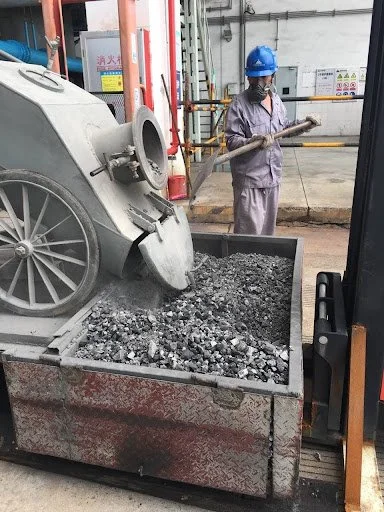
A worker manually shovels mill rejects. Hopper temperatures at this location run up to 200°C during normal operation.

THE SOLUTION
What Was Installed
The system uses a positive-displacement Roots blower to draw the entire conveying network to a sustained vacuum of up to −75 kPa. From each mill's pyrite hopper, sealed conveying pipelines route overhead through the boiler basement to a central cyclone/bag-filter separator. Separated rejects drop by gravity into a storage silo; filtered air passes through an air-cooled heat exchanger and discharges to atmosphere via the bag collector.
The twelve mills run as two independent six-mill circuits — one per boiler — each with its own blower rated at 4,500 m³/h. Conveying capacity reaches 30 t/h, handling material up to 50 mm particle size. That covers the full reject stream including occasional oversized tramp material that gets through the mill internals.
No personnel. No forklifts. No open transfer points. The system cycles through all hoppers automatically under DCS control, 24 hours a day.
OPERATING RESULTS
BY THE NUMBERS
The system has run continuously since 2015 commissioning. Maintenance has consisted of scheduled elbow liner inspection and periodic replacement — consistent with running abrasive, angular reject material at up to 30 t/h through steel elbows. In over ten years of operation, maintenance has been limited to scheduled elbow replacement — no operational interruptions have been attributed to the conveying system.
The cost data comes from the plant's pre-retrofit accounting and post-installation operating records.
| Cost Item | Before Retrofit | After Retrofit |
|---|---|---|
| Gate valve and seal replacement, 12 mills | ¥120,000 (~$18,500)/yr | Eliminated |
| Forklift depreciation and maintenance, 2 units | ¥100,000 (~$15,500)/yr | Eliminated |
| Forklift operators, 2 FTE (wages + benefits) | ¥400,000 (~$61,500)/yr | Eliminated |
| Housekeeping, 1 FTE (wages + benefits) | ¥150,000(~$23,000)/yr | Eliminated |
| System electricity and maintenance | — | ¥170,000 (~$26,000)/yr |
| Total Annual Cost | ¥770,000(~$118,500)/yr | ¥170,000(~$26,000)/yr |
Operating cost methodology: ¥170,000/yr calculated from actual runtime data — one 660 MW boiler running 5,000 hr/yr at ¥0.30/kWh, one conveying cycle per hour. Cross-checked and confirmed against a separate 1,000 MW unit installation. Note: Cost and labor figures reflect Asia rates.
mill reject duty
across 12 mills (~$23,400 USD)
zero system-caused downtime
GET IN TOUCH